The final year of the project has begun, and the final tests and experimental validations are about to take place. This led to an exciting exchange of insights at the 36M consortium meeting of the SOMMER project.
At Haldenwanger’s invitation, the project participants met in Waldkraiburg, Germany. The project member Morgan Advanced Materials Haldenwanger GmbH is a long-established German manufacturer of technical ceramics and laboratory porcelain.
Valuable discussions on current work
For two days, the consortium discussed the current progress in the various work packages. Task leaders presented the latest developments and ongoing research activities, fostering valuable discussions and collaboration across the consortium.
Current work includes:
- Manufacturing of membranes with extrusion and 3D printing
- Kinetic measurements
- Application-oriented testing
- Membrane reactor design and testing
- Techno-economic and life-cycle assessment
- System integration into a cement plant
The consortium is very pleased with the current progress of the project and the excellent collaboration among the project participants. Only by working together can they achieve their goal of developing sustainable technology to convert CO2 and H₂O into syngas – a raw material for many chemical products.
A tour of the Haldenwanger production facilites
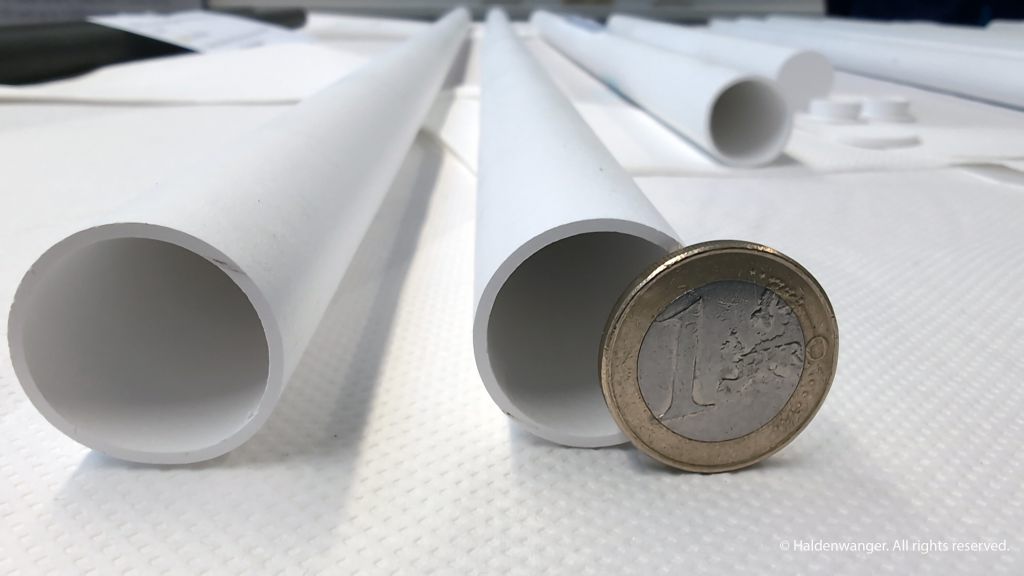
Participants in the SOMMER consortium meeting toured Haldenwanger’s production facilities and saw how the team makes technical ceramics for high-temperature industrial applications, including tubes, kiln furniture, and custom components. The tour also showed how Haldenwanger uses extrusion to manufacture ceramic membrane tubes for the SOMMER project. These tubes will be used in the DLR reactor, where they will be heated to 900 Degrees Celsius in off-sun tests and up to 1500 Degrees Celsius under solar irradiation in on-sun tests.
A sincere thank you to the Haldenwanger team for organising and hosting this successful meeting, and to all participants for their active engagement and valuable contributions. The consortium looks forward to the final phase of the project towards achieving the SOMMER’s ambitious goals.