The paper “Thermodynamic stability of doped ceria for solar reactors: Sublimation and surface segregation” has been published in the Journal Open Ceramics. In cooperation with the DLR Institute of Frontier Materials, scientists from the SOMMER team at Forschungszentrum Jülich tackled the crucial obstacle for solar‑thermochemical fuel reactors: the rapid degradation of the benchmark oxide Gd₀.₁Ce₀.₉O₁.₉₅ (GDC‑10) under the extreme conditions required for solar‑fuel production.
Results (in a nutshell):
- Low total pressure, not oxygen‑partial pressure, drives CeO₂ loss.
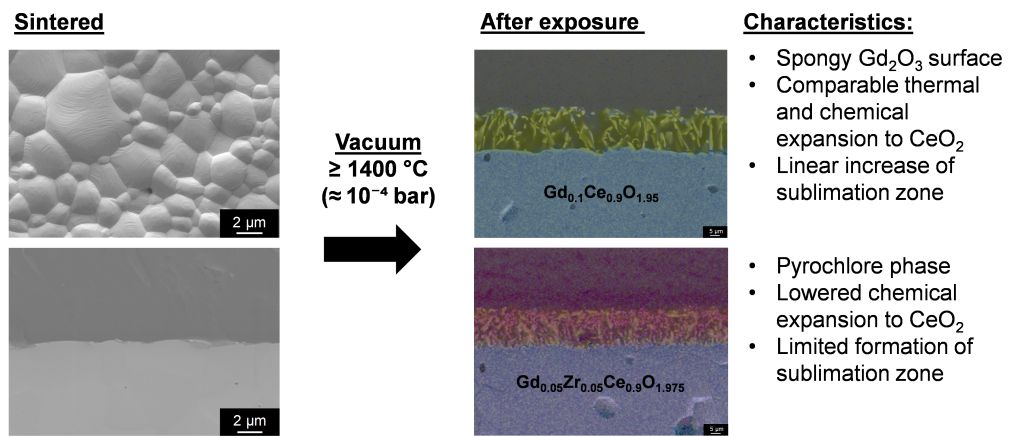
In a vacuum of ≈10⁻⁴ bar at 1400 °C a porous, Gd‑rich “sponge‑like” surface forms; the same treatment in Ar leaves the material dense. - Surface degradation follows Hertz‑Knudsen‑Langmuir kinetics and is diffusion‑controlled (parabolic law up to ~20 h).
- Zirconium co‑doping (5 mol % Zr) stabilizes the oxide.
The Zr‑containing composition (Ce₀.₉Gd₀.₀₅Zr₀.₀₅O₁.₉₇₅) quickly reaches a saturated surface state, shows a new pyrochlore phase, and dramatically reduces CeO₂ volatilization after ageing. - Mechanical integrity improves.
Dilatometry reveals lower chemical expansion and shorter relaxation times for the Zr‑doped material, meaning fewer cracks during redox cycling.
Part of SOMMER research
The stability of ceria‑based redox oxides under high‑temperature solar‑thermal operation is crucial for fuel‑producing reactors – like the one which is being developed within the SOMMER project. The aim of the project is the development of a sustainable technology for converting CO2 and water into synthesis gas, a raw material for many chemical products.
Open Ceramics is an official, peer-reviewed, open access journal of the European Ceramic Society. The international journal publishes the results of original research, as well as reviews and perspective articles relating to all classes of ceramic materials. The central objective of Open Ceramics is to provide a venue for the dissemination of high quality, novel research and technological developments in ceramic and inorganic materials, targeting a wide audience ranging from academia to industry.
Read the full paper here: Thermodynamic stability of doped ceria for solar reactors: Sublimation and surface segregation – ScienceDirect